How to Create a Website from Scratch in Nigeria: The Complete Step-by-Step Guide for 2026
Every guide on how to create a website from scratch was written for someone else. They assume you have a Visa card ready for Squarespace, a stable broadband connection, and a business that operates in dollars. They don’t mention Flutterwave. They don’t talk about mobile-first design for an audience where 83% of web traffic comes from a phone. They don’t warn you that the ₦15,000 cousin-built website is going to cost you three times that in lost customers before you realise what went wrong.
This guide is for Nigerian entrepreneurs, creators, and small business owners who want to build a website that actually does something — attracts customers from Google, collects leads, and makes the business look like it belongs in the conversation with the big players. Not a placeholder. Not a digital brochure. A working business tool.
I’ve built websites across Lagos for law firms, pharmacies, auto workshops, logistics companies, food brands, and digital service providers. The ones that generate real enquiries share a specific set of decisions made before anyone touches a colour palette. The ones that sit there doing nothing share a different set of decisions — most of which were made without the right information. This guide gives you the right information, in the right order, for the Nigerian market specifically.
By the end, you’ll know exactly how to create a website from scratch — what to buy, where to buy it, what to build, and what to avoid. If at any point you decide you’d rather have it built properly without the learning curve, our full range of services exists precisely for that.
The Gap Nobody Talks About: Having a Website vs Having One That Works

Nigeria has more websites than most people realise. Walk into any business cluster in Lekki, Ikeja, or Wuse 2 and a significant number of those businesses have a web address on their business card. The problem is that most of those websites have never generated a single customer enquiry that didn’t start with a referral or a direct WhatsApp message from someone who already knew the business existed.
The website exists. The website works. But it isn’t working.
The gap between those two things is where most Nigerian business owners lose money without knowing it. Here’s what’s actually happening. A potential customer in Lagos searches “trusted logistics company Lagos” or “pharmacy near me Abuja” or “best catering service Port Harcourt.” Google serves them a list. That list contains businesses with websites that were built with search in mind — pages structured properly, content that answers the searcher’s question, a clear action to take when they arrive. The businesses without that infrastructure don’t appear. The potential customer never even knows they exist.
This isn’t a traffic problem. It’s a foundation problem. And it starts at the very beginning — at the moment the website is being built. Most people approach website creation as a design exercise: pick a template, add some photos, write a few paragraphs about the business, and publish. That approach produces a website that looks fine and does nothing. The businesses winning on Google approached it as a customer acquisition exercise from day one — every structural decision made with the question: how does this help someone find us, trust us, and contact us?
If you’re going to invest the time and money to create a website from scratch, it should be built to work. That means understanding what a working website actually requires — and making those decisions before you buy a domain or open a page builder.
Why Most Nigerians Build the Wrong Website
The most common reason Nigerian business owners end up with a non-performing website is straightforward: they followed advice that wasn’t designed for them. YouTube tutorials walk through Wix or Squarespace setups optimised for Western markets. Facebook groups recommend whichever platform the person answering has personally used. A cousin or friend who “knows tech” builds something that looks decent on their laptop but breaks on the Android phones their customers are actually using.
Platform choice is where the first wrong turn usually happens. Wix and Squarespace are genuinely good products — in the right context. That context is a business that doesn’t need local SEO dominance, doesn’t need deep integration with Nigerian payment systems, and doesn’t need a blog or content strategy to drive organic traffic. For a Nigerian business trying to rank on Google, capture leads, accept Naira payments online, and scale the site as the business grows, neither platform gives you the control you need. You hit the ceiling fast and rebuilding is expensive.
The second wrong turn is treating the website as a one-time project rather than an ongoing channel. A website that isn’t updated, doesn’t publish content regularly, and has no strategy for growing its search presence will decline in relevance over time. Google favours websites that are active, authoritative, and consistent. A site built in 2023 and untouched since is losing ground to competitors every month — even if those competitors started later.
The third wrong turn — and this one is specifically Nigerian — is underestimating mobile performance. Building and previewing on a laptop produces a site that looks excellent on a 15-inch screen and loads in two seconds on fibre. That same site on a 4G connection in Surulere on an Infinix Hot can take eight seconds to load and look completely broken. Eight seconds is not a slow website in Nigeria — it’s an empty website. The user left at three.
None of these mistakes are the business owner’s fault. They’re the result of following generic advice in a specific context. The fix is a framework built for that context from the start.
The A.C.E. Framework Applied to Building Your Website from Scratch
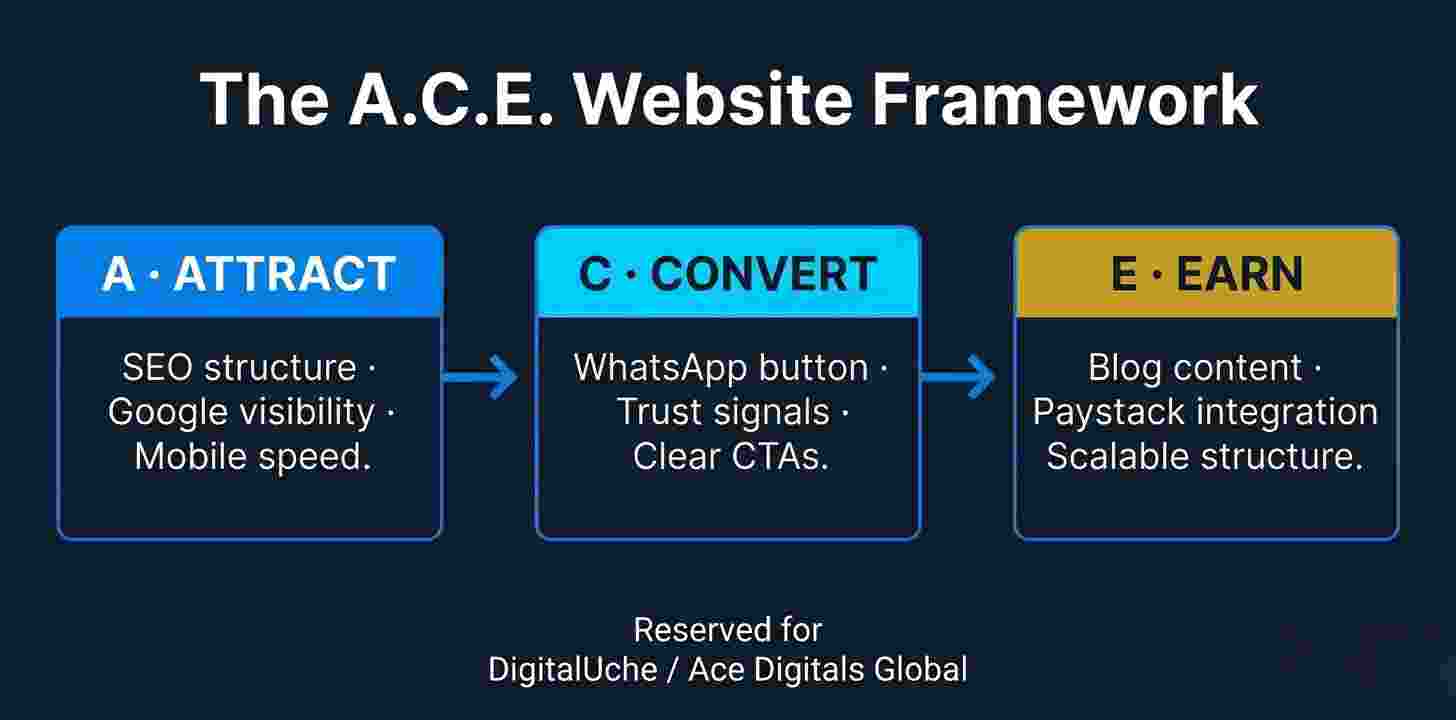
Before touching a domain registrar or a page builder, the website needs a strategic blueprint. The A.C.E. Monetization Framework — Attract, Convert, Earn — gives you that blueprint. Every structural decision in your website build maps to one of these three stages. If a decision doesn’t serve any of them, it shouldn’t be in the build at all.
A — Attract: Build for Discovery, Not Just Appearance
The Attract stage is about making sure the right people can find your website in the first place. For a Nigerian business, this means building with local SEO as a core structural requirement — not an afterthought. Your domain name, your page structure, your headings, your image file names, your page load speed, your mobile responsiveness: every one of these signals to Google whether your website deserves to appear when someone searches for what you offer in your city.
Practically, this means choosing WordPress as your platform (more on why below), installing a solid SEO plugin like Rank Math, structuring each page around a specific search query your customers actually type, and writing content that answers real questions. A website without an Attract strategy is invisible. You can’t convert visitors you never had.
C — Convert: Turn Visitors into Enquiries
Once someone lands on your website, the Convert stage determines whether they contact you or click back to the search results. Most Nigerian business websites fail here because they were designed to present information rather than prompt action. There’s a difference. A website that presents information tells you what the business does. A website built to convert tells you what to do next — and makes doing it as easy as possible.
For a Nigerian audience, conversion means a WhatsApp button in the header that works in one tap. It means a contact form that loads fast on mobile. It means trust signals — client logos, results, testimonials, a real address — placed exactly where a hesitant visitor needs reassurance before they commit to reaching out. Every page of your website should have one clear primary action and no competing distractions pulling the visitor away from it.
E — Earn: Build a Platform That Grows Revenue Over Time
The Earn stage is about building a website that generates income consistently — not just when you’re actively posting on Instagram or running ads. This means your website needs a blog that builds search authority over time, a services or product structure that can be expanded without a full rebuild, and the capability to integrate payment systems like Paystack or Flutterwave when you’re ready to sell online. WordPress handles all of this natively. That’s why it powers 43% of all websites on the internet and why it’s the right foundation for any Nigerian business that plans to grow. Check our post on Best Website Builders for Small Business in Nigeria for the full platform comparison if you want to see how WordPress stacks up against the alternatives.
Step-by-Step: How to Create Your Website from Scratch in Nigeria
Here’s the exact process — in order. Don’t skip steps. Each one depends on the previous one being done correctly.
Step 1 — Define Your Website’s Purpose Before Anything Else
Write down in one sentence what you want your website to do. “I want my website to generate enquiries from people in Lagos searching for [your service].” That sentence governs every decision that follows. If a design choice, a page, or a feature doesn’t serve that sentence — it doesn’t go in the website. This step takes twenty minutes and saves you three months of rebuilding later.
Step 2 — Choose and Register Your Domain Name
Your domain name is your website’s address — yourbusiness.com. Keep it short, memorable, and close to your business name. Avoid hyphens, numbers, and anything that requires spelling out over the phone. For Nigerian businesses, a .com extension is still the strongest trust signal even though .com.ng exists. Register your domain through Namecheap (accepts cards and sometimes crypto) or Whogohost (accepts Naira bank transfer and cards — ideal for Nigerian payment methods). Expect to pay between ₦8,000–₦15,000 per year for a .com domain depending on the registrar and exchange rate at the time.
Step 3 — Purchase Web Hosting
Hosting is the server where your website files live. For Nigerian businesses, your two most reliable options are Whogohost and Truehost Nigeria — both accept Naira payments, have local customer support, and offer servers with reasonable speed for Nigerian users. For a starting business, a shared hosting plan at ₦15,000–₦40,000 per year is sufficient. As your traffic grows, you’ll move to a VPS plan — but that’s a future problem. When purchasing hosting, make sure the plan includes a free SSL certificate (the padlock in the browser address bar — Google penalises sites without it) and at least one-click WordPress installation.
Step 4 — Install WordPress
Once your hosting is live, log into your cPanel (your hosting dashboard) and find the Softaculous Apps Installer. Click WordPress, click Install, fill in your site name and admin details, and it’s live in under three minutes. WordPress is free. What you pay for is the hosting that runs it. After installation, log into your WordPress dashboard at yourwebsite.com/wp-admin with the credentials you just created. This is where your entire website will be managed going forward.
Step 5 — Install a Theme and Essential Plugins
A WordPress theme controls how your website looks. For a business website, avoid free themes from unknown developers — they’re often slow, poorly coded, and abandoned. The Astra theme (free version is excellent) or GeneratePress are the two most reliable free options for Nigerian business websites. After your theme, install these five plugins immediately: Rank Math SEO (handles all your SEO settings), WP Rocket or LiteSpeed Cache (makes your site load faster), Smush (compresses your images automatically), Fluent Forms (contact forms), and UpdraftPlus (automatic backups). These five plugins alone will put your site ahead of 80% of Nigerian business websites in terms of technical performance.
Step 6 — Build Your Core Pages
Every business website needs five pages minimum: Home (your strongest first impression — who you are, what you do, who it’s for, what to do next), About (builds trust — your story, your team, your location, why you specifically), Services (one section or one full page per service — each optimised for a search keyword), Blog (your long-term SEO engine — even two posts a month compounds significantly over a year), and Contact (your WhatsApp link, phone number, email, and a form — make it stupidly easy to reach you). Don’t launch without all five. A website missing any of these is leaving customer trust on the table.
Step 7 — Connect Your Domain, Add SSL, Test, and Launch
If you registered your domain separately from your hosting, you’ll need to point the domain’s nameservers to your hosting provider — your host’s support team can walk you through this in ten minutes. Once connected, activate your SSL certificate from cPanel (it’s usually one click under “SSL/TLS”). Then test your website on your own mobile phone on 4G — not on WiFi, not on a laptop. Walk through every page. Click every button. Fill in your contact form. If anything breaks or loads slowly on your phone, fix it before you announce the site. Your customers are on mobile. Test on mobile.
What Actually Makes a Nigerian Website Work After Launch
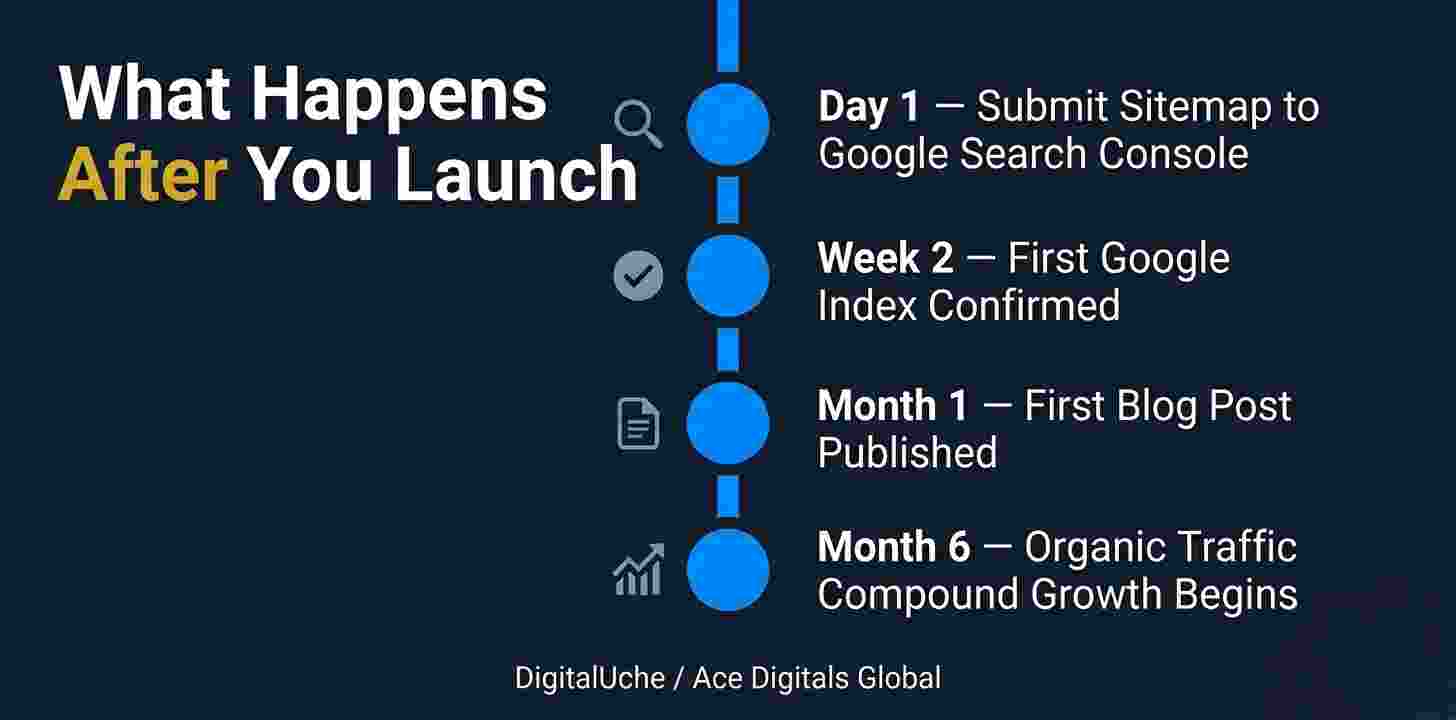
Most website guides end at launch. This section is about what happens next — because the difference between a website that starts generating enquiries within 60 days and one that sits there for two years doing nothing is entirely about what the business owner does after they click publish.
The first thing that matters is Google Search Console. This is a free tool from Google that shows you exactly how your website is performing in search — which keywords you’re appearing for, which pages Google has indexed, and what technical errors need fixing. Submit your sitemap to Google Search Console within the first 48 hours of launch. Without this, Google is finding your site on its own timeline — which could be weeks. With it, you’re telling Google your site exists and requesting it be crawled. This is not optional if you care about search traffic.
The second thing that separates performing websites from dead ones is content consistency. One blog post published the month you launched and nothing since is not a content strategy. Google’s algorithm rewards websites that are active, authoritative, and consistent. Two solid, well-researched blog posts per month — each targeting a specific keyword your customers search — compounds into significant search visibility within six to twelve months. We’ve seen this pattern across every client we’ve built websites for. The businesses that commit to content in the first year own their local search category by year two. The ones who don’t are still paying for Instagram ads in year three wondering why organic traffic never came. Our post on Why Is My Website Not Getting Traffic in Nigeria goes deep on exactly why this happens and how to fix it.
The third factor is page speed on mobile networks. Nigerian internet speeds are improving but remain inconsistent. A website that loads in 2.1 seconds on Lagos fibre loads in 6.8 seconds on 3G in Kano. Your target should be a Google PageSpeed score of 85 or above on mobile — achievable with the right hosting, a lightweight theme, compressed images, and a caching plugin. Every second of load time above three seconds costs you approximately 20% of your visitors. That’s not a statistic to bookmark — it’s revenue leaving your business every day your site is slow.
Finally — and this is the thing almost nobody does — set up Google My Business the same week your website launches. A verified Google My Business profile linked to your website creates a second entry point on Google — the map listing that appears when someone searches your service type near your location. For local Nigerian businesses, this is often the highest-converting traffic source available. It’s free, it takes 30 minutes to set up, and it starts generating calls and direction requests within weeks of verification.
5 Mistakes to Avoid When Creating Your Website from Scratch
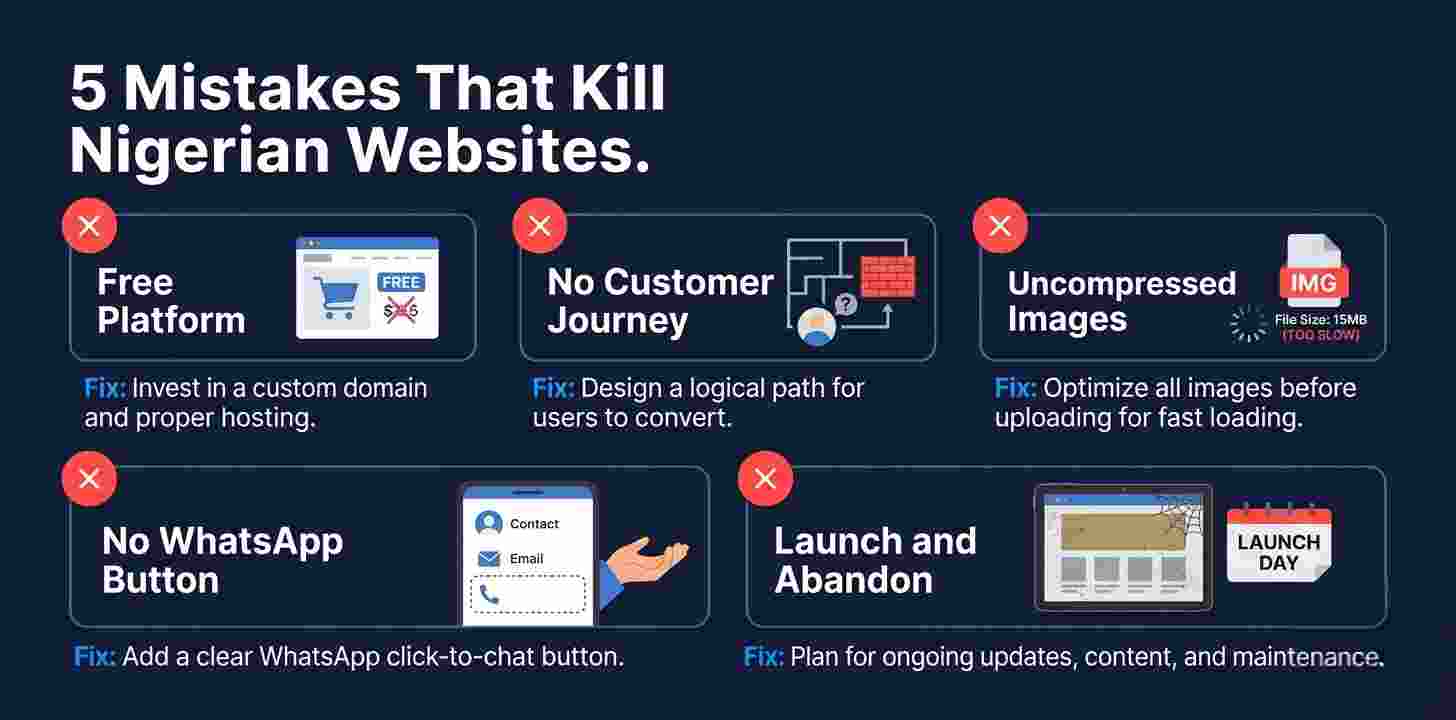
Choosing a Platform Based on What’s Free
Free website builders feel like a smart decision until you hit their limitations at exactly the moment your business needs to grow. Wix’s free plan shows Wix branding on your domain. Blogger gives you a .blogspot address that signals to every visitor that you couldn’t afford a real website. The cost of proper hosting and a domain is between ₦25,000–₦55,000 per year. That is the cheapest marketing spend in your entire business. A professional web address on fast hosting with WordPress installed is the foundation — don’t compromise on the foundation to save ₦20,000.
Building the Website Before Defining the Customer Journey
A website built without a defined customer journey is a collection of pages with no direction. Before you design anything, map out: who lands on your site, what question they have, what page answers it, and what they should do next. Every page needs a next step. If a visitor reads your About page and there’s no clear action to take, you’ve lost them. The customer journey should be designed before the first page is built — not retrofitted after launch when you notice nobody’s converting.
Using Uncompressed Images
This is the single most common technical mistake on Nigerian business websites. A photo taken on an iPhone or high-end Android is typically 3–8MB. Uploaded directly to WordPress, that image forces every visitor to download 8MB just to see one picture. On a mobile connection, that alone can make your site take ten seconds to load. Every image on your website should be compressed to under 200KB before uploading — use Squoosh.app (free, browser-based) or install the Smush plugin which does it automatically. This one change can cut your page load time in half.
No WhatsApp Integration
Nigerian customers prefer WhatsApp over email by a significant margin. A website with only an email contact form is losing the majority of potential enquiries before they happen. Add a WhatsApp chat button to your website — it should be visible on every page, ideally floating in the bottom right corner. When a visitor taps it, it should open a pre-filled WhatsApp message so they don’t have to think about what to say. This single addition has consistently increased enquiry rates for every business website we’ve built. It costs nothing to implement and changes everything.
Launching and Abandoning
A website is not a sign you hang outside your shop once and forget. It’s a channel — and channels require consistent attention. The businesses we see struggling two years after launch are almost always the ones that treated website creation as a one-time project. No new content, no updated service pages, no performance monitoring. Google notices inactivity. Competitors who are actively publishing and optimising will outrank you — not because their business is better, but because their digital presence is more current. Build a simple maintenance habit: one new blog post per month, a quarterly review of your core pages, and monthly checks on your Google Search Console data.
Real Results: What Happens When a Nigerian Website Is Built Right
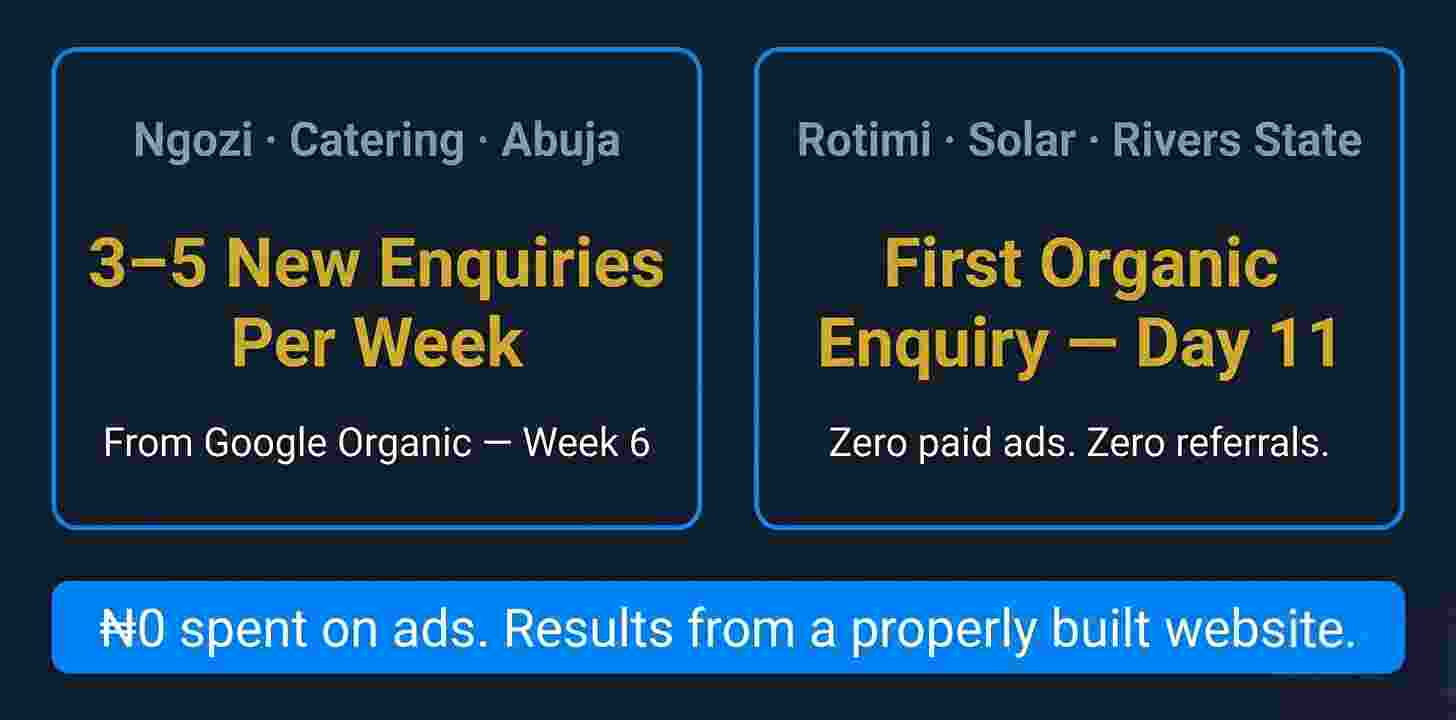
Ngozi runs a catering business serving corporate clients in Abuja. Before her website, every client came through referral — which meant income was unpredictable and entirely dependent on who happened to mention her name in the right conversation. She came to Ace Digitals Global wanting something that could generate clients on its own, without her having to hustle every single one.
We built her a WordPress website optimised for local search terms — “corporate catering Abuja,” “event catering Wuse,” “small chops delivery Abuja” — with a mobile-first design, a Paystack-integrated booking deposit system, and a WhatsApp button that pre-filled a message with her standard enquiry questions. Within six weeks of launch, she was receiving three to five new enquiries per week from Google alone — people who had never heard of her before and found her purely through search. By month three, she had stopped relying on referrals entirely and had a waiting list for the first time in four years of running the business.
Rotimi owns a solar installation company operating across Rivers State. His previous website was built by a freelancer for ₦40,000 — it existed, had some photos of past installations, and had generated zero enquiries in eighteen months. We rebuilt it from scratch on WordPress with service pages targeting specific search queries like “solar installation Port Harcourt” and “solar panel companies Rivers State,” added a detailed FAQ section that answered the questions his customers always called to ask, and integrated a WhatsApp quote request flow. He received his first organic enquiry eleven days after the new site launched.
“I didn’t realise my old website was invisible on Google until I saw what a properly built one could do. The difference wasn’t the design — it was the strategy behind the design.” — Rotimi, solar installation company, Rivers State
Both of these outcomes started with the same decision: building the website for customers, not for appearances. That decision, made at the beginning of the project, determined everything that followed. If you’re ready to make that decision for your business, the next step is a conversation — not a quote form, not a waiting list.
Your Business Deserves a Website That Works as Hard as You Do
Tell us what your business does and what you want your website to achieve. We’ll tell you exactly how to make it happen — whether you build it yourself or let us build it for you.
Frequently Asked Questions
How much does it cost to create a website from scratch in Nigeria?
The baseline cost for a self-built WordPress website in Nigeria is ₦25,000–₦55,000 per year — covering domain registration (₦8,000–₦15,000) and hosting (₦15,000–₦40,000). WordPress itself is free. If you hire a professional agency to design and build the site, expect to pay between ₦150,000 and ₦600,000+ depending on the number of pages, complexity, and the experience of the agency. The ₦15,000–₦40,000 “cousin” websites exist — but the majority of them produce websites that generate zero customer enquiries and require a full rebuild within twelve months. Budget for the right foundation the first time.
Can I create a website for free in Nigeria?
Technically yes — platforms like WordPress.com (not to be confused with WordPress.org), Wix, and Weebly offer free tiers. In practice, free website plans come with significant limitations: your address will be something like yourbusiness.wixsite.com instead of yourbusiness.com, the platform’s branding will appear on your site, you’ll have no access to SEO tools, and you cannot integrate Nigerian payment systems. For a personal portfolio or hobby project, a free plan is fine. For a business that needs to generate customers, revenue, and trust — a free website actively works against you. The investment in proper hosting and a domain is minimal compared to what it enables.
How long does it take to build a website from scratch?
A self-built WordPress website with five core pages can be created in one to two weeks if you’re learning as you go, or in two to three days if you’re following a clear process and already have your content ready. The most time-consuming part is almost always the content — writing the copy for each page, gathering photos, and deciding what to say and how to say it. A professionally built website from an agency typically takes two to four weeks from kickoff to launch, depending on how quickly the business owner provides content and feedback. The technical build is fast. The content is where most timelines slip.
What do I need before I start building my website?
Before you touch any platform or pay for any service, have these five things ready: your business name and the exact domain you want (check it’s available at Namecheap before committing), a clear description of what your business does and who it serves (this becomes your homepage headline), your contact details including a WhatsApp business number, at least five to eight high-quality photos of your business, products, or services, and a list of the three to five services or products you want to feature. Walking into a website build without these is the fastest way to stall halfway through and end up with a half-finished site sitting in your drafts for six months.
Should I build my website myself or hire someone?
Build it yourself if you have time to learn, your business is in an early stage and budget is genuinely tight, and you’re comfortable troubleshooting technical issues. Hire a professional if your time has significant value elsewhere, you need the site to perform from day one rather than after a six-month learning curve, or your business is at a stage where a poor website is costing you customers. The honest answer is that most business owners who build their own websites spend three to four months getting something live that a good agency would have delivered in three weeks — and the self-built version often lacks the SEO structure and conversion design that makes the difference between a website that works and one that doesn’t. Read our guide on How to Get Your First 100 Customers Online to understand how a website fits into the broader customer acquisition picture.
What is the difference between a domain and hosting?
Your domain is your website’s address — the name people type to find you (e.g. yourbusiness.com). Your hosting is the server where your website’s files are stored and delivered to visitors when they type that address. You need both. Think of it this way: the domain is your street address and the hosting is the building at that address. You can register them from the same provider (convenient) or separately (sometimes cheaper). If you register them separately, you’ll need to point your domain’s nameservers to your hosting provider — a five-minute process your host’s support team can guide you through.
How do I get started with Ace Digitals Global?
The fastest way is a direct WhatsApp message — no forms, no waiting, no generic quote request process. Message DigitalUche at +234 907 958 1937, describe your business and what you want your website to do, and you’ll get a straight response with a clear next step. You can also explore our full range of services to understand what’s included before reaching out.

The Last Thing You Need to Know Before You Start
Creating a website from scratch in Nigeria is not complicated. The technology is accessible, the costs are reasonable, and the platforms — WordPress especially — have made the technical barrier lower than it’s ever been. What separates the businesses with websites that generate customers from the ones with websites that don’t isn’t money or technical skill. It’s the decision, made at the very beginning, to build for customers rather than for appearances.
Every step in this guide exists to make that decision easier to act on. Choose the right platform, buy proper hosting, structure your pages for search, test obsessively on mobile, publish content consistently, and connect everything to Google Search Console. Do those things and your website will work. Skip them in favour of a faster launch or a cheaper shortcut and you’ll be back at this point in twelve months, starting over.
If you want it done properly without spending the next few months learning what professionals already know — that’s exactly what Ace Digitals Global does. We’ve built websites for businesses across Nigeria. We know what works here, what Google rewards here, and what Nigerian customers respond to. The conversation starts on WhatsApp.
Ready to Build a Website That Actually Brings You Customers?
Stop putting it off. One conversation is all it takes to get clarity on exactly what your business website should look like and what it should do.
The website you build this month will either be paying you back in two years or costing you in customers you never knew you lost. The difference is the decisions you make before you start.

Uchenna Richard — DigitalUche
Founder of Ace Digitals Global. Lagos-based digital marketing strategist helping Nigerian entrepreneurs build websites and run ads that actually convert. Follow on Instagram @DigitalUche.
Want This Implemented for Your Business?
Book a free 30-minute strategy call with DigitalUche — no obligation, just real advice.

Uchenna Richard — DigitalUche
Founder & CEO — Ace Digitals Global
Lagos-based digital marketing strategist helping Nigerian entrepreneurs build websites and run ads that actually convert. Follow on Instagram @DigitalUche.