
What Nobody Tells You About Why Facebook Ads Fail — And What to Do Instead

You’ve spent real money on Facebook ads. Maybe ₦20,000. Maybe ₦50,000. Maybe more. And the results? A handful of likes, a few profile visits, and zero enquiries. That’s the story I hear almost every week from Nigerian business owners who came to Ace Digitals Global frustrated, confused, and convinced that ads simply don’t work for them.
They do work. Just not the way most people are running them.
The reason why Facebook ads fail for the majority of Nigerian entrepreneurs has nothing to do with their budget being too small, the algorithm being unfair, or their business being “too local” for digital ads. The real reasons are quieter, more specific, and almost never discussed in the generic YouTube tutorials or ₦5,000 courses people buy hoping for shortcuts.
I’ve managed ad campaigns for service businesses, product brands, and creators across Nigeria. I’ve seen exactly where money disappears — and I’ve seen what happens when the same budget is spent correctly. The difference isn’t dramatic. It’s structural. And once you understand the structure, everything changes.
This post is going to show you what’s actually going wrong with your Facebook and Google ads — and give you a clear framework for fixing it. Whether you’re running ads yourself or about to hire someone to do it for you, what follows will save you from the most expensive mistakes in the game.
The Painful Truth About Where Your Ad Budget Is Going
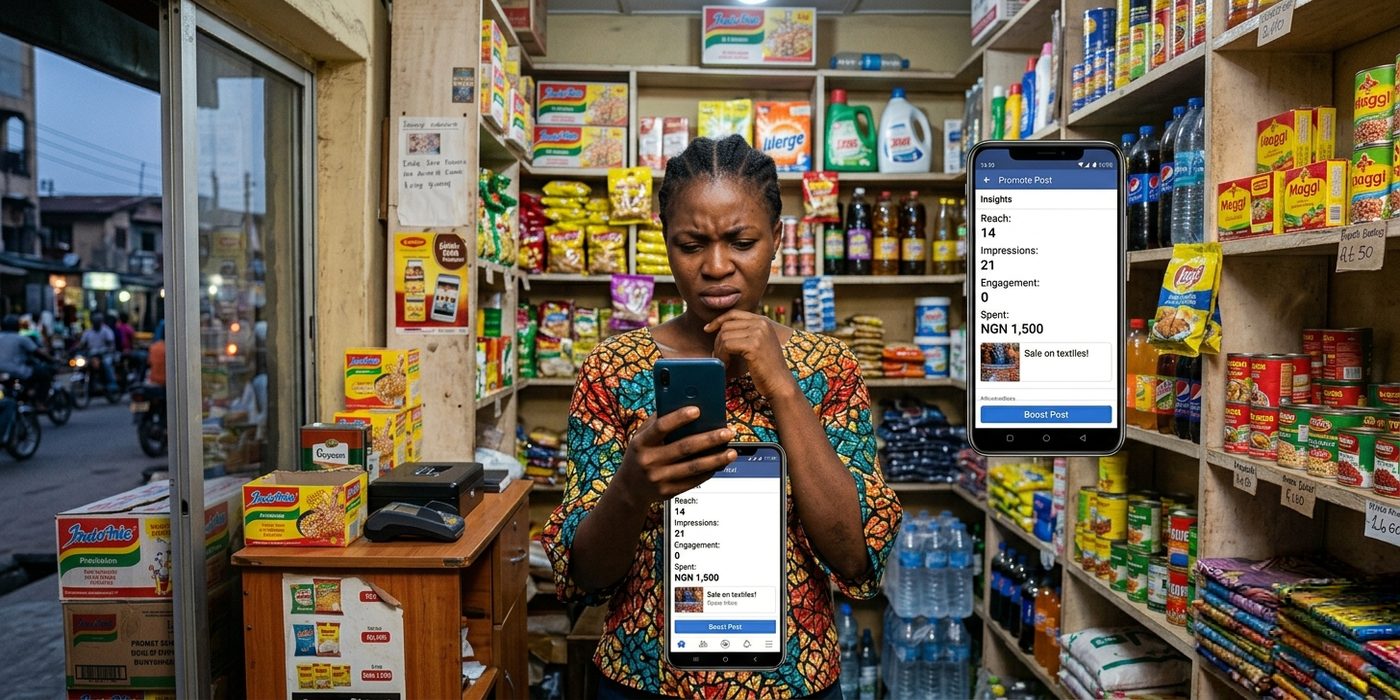
Here’s what’s actually happening when you boost a post or launch an ad and nothing comes back. Facebook takes your money — that part works perfectly. Your ad gets shown to people — that happens too. But those people see your ad, feel nothing specific, click nothing, and scroll on. You pay for every single one of those impressions and get nothing in return.
The brutal reality is that most Nigerian small business owners are running what the industry calls “awareness spend” — money that circulates without any mechanism to convert the attention it generates into an action. No clear offer. No destination that captures the lead. No reason for the viewer to do anything other than double-tap and keep scrolling.
Facebook’s algorithm is not your enemy. It’s genuinely one of the most sophisticated targeting tools ever built. It can find your ideal customer in Lagos, Abuja, or Port Harcourt with frightening precision — but only if you tell it what to look for and give it a landing destination worth sending people to. Most campaigns skip both of those steps entirely.
Google Ads compounds the same problem differently. People search for your service, your ad appears, they click — and you pay for that click — but they land on a generic website with no clear next step. They leave. You’ve bought a visit that converted into nothing.
In both cases, the platform is doing its job. The campaign structure is what’s broken. And that’s the conversation nobody is having loudly enough in this market.
Why Facebook Ads Fail Has Nothing to Do With Facebook
The most dangerous belief in Nigerian digital marketing right now is this: “I tried ads and they didn’t work.” That sentence has cost thousands of business owners months — sometimes years — of delayed growth, because it leads them to abandon the one channel that, properly structured, would transform their business.
Here’s the reframe. When your Facebook ads don’t convert, Facebook isn’t failing you. Your offer is unclear, your targeting is too broad, your creative doesn’t stop the scroll, your landing page doesn’t exist, or your ask is premature. Usually, it’s a combination of all five. The platform delivered exactly what it was asked to deliver — it just wasn’t asked the right questions.
Boosting a post is not running an ad. This distinction is critical. Boosting is a feature designed for reach — it shows your content to more people. Running a proper Facebook Ads campaign through Ads Manager is a precision tool — it finds specific people based on behaviour, interest, and intent, sends them to a destination designed to convert, and optimises over time based on what’s working. One buys visibility. The other buys results. They are not the same product.
I’ve worked with business owners who had spent upwards of ₦100,000 “on ads” — every naira of it boosted posts — and had nothing to show for it. The same monthly budget, restructured into a proper campaign with a real offer and a WhatsApp landing page, produced enquiries within the first week. Nothing about the business changed. Only the structure changed.
That’s the conversation this post exists to have.
The A.C.E. Framework: How to Run Ads That Actually Convert

At Ace Digitals Global, every paid campaign we build — whether it’s Facebook, Instagram, or Google — runs through the same three-phase structure. We call it the A.C.E. Monetization Framework. It’s not a theory. It’s the operating system behind every campaign that’s actually produced results for our clients. And understanding it will immediately show you where your current campaigns are breaking down. You can also explore our full range of services if you’d rather have us build and manage this for you from the start.
A — Attract: Getting the Right Eyes on Your Ad
The Attract phase is where most Nigerian business owners spend all their attention — and still get it wrong. Attraction isn’t about reach. It’s about relevance. Your ad needs to stop the right person mid-scroll, not just get shown to a large number of people. That distinction changes everything about how you build your campaign.
Start with your audience definition. In Facebook Ads Manager, you have access to interest-based targeting, behavioural targeting, lookalike audiences (built from your existing customer list or website visitors), and custom audiences from your own data. Using broad targeting on a Nigerian ad account is one of the fastest ways to drain your budget — Facebook will show your ad to whoever is cheapest to reach, not whoever is most likely to buy from you.
Your creative — the image or video — is doing a job before anyone reads a single word of your copy. It has approximately 1.3 seconds to stop a thumb. In the Nigerian feed, where every competitor is running the same stock-photo aesthetic, a real image of your actual service, your actual team, or a real result your business has delivered will outperform a designed graphic almost every time. Authenticity stops the scroll. Polish without context does not.
Your ad copy should open with the problem, not the product. “Is your office space looking embarrassing on client visits?” will outperform “We offer professional cleaning services in Lagos” every single time — because one speaks directly to a feeling your ideal client is already experiencing, and the other just announces your existence.
C — Convert: Turning Clicks Into Actual Leads
This is the phase that separates campaigns that generate enquiries from campaigns that generate traffic with no outcome. Every click your ad generates costs money. Where that click lands determines whether you get a return on it or not.
The single most effective conversion destination for Nigerian service businesses right now is a WhatsApp landing page — a simple, mobile-optimised page with one clear offer, a few trust signals (photos, a brief description, maybe one testimonial), and a single button that opens a pre-filled WhatsApp message. It removes every barrier between “I’m interested” and “I’m talking to someone.” No form to fill. No email to send. No waiting. The friction disappears.
If you’re sending ad traffic to your Instagram page, your general website homepage, or — worst of all — nowhere (link-click ads that go to a Facebook post) — you are converting almost no one. People who click ads are warm but impatient. Give them exactly what they came for or they leave, and you’ve paid for nothing.
Your offer also matters here. “Contact us for more information” is not an offer. “Get a free cleaning quote for your office this week — spaces limited” is an offer. Specificity, urgency, and clarity at the conversion point are what turn browsers into buyers.
E — Earn: Making the Campaign Profitable Over Time
The Earn phase is where the campaign graduates from “generating leads” to “generating consistent revenue” — and it’s almost entirely about what happens after the first enquiry. Most business owners treat ads as a tap they turn on and off. The ones who build real income from paid campaigns treat every lead as the beginning of a relationship, not the end of a transaction.
Follow up. Every enquiry that doesn’t convert on the first message is not a lost lead — it’s a warm contact who needs one more touchpoint. A WhatsApp broadcast list of people who enquired but didn’t book is worth money. A retargeting campaign on Facebook showing a different angle to people who clicked your first ad but didn’t convert costs a fraction of your original campaign and closes a percentage of people who were almost ready.
This is the level where ad campaigns become business infrastructure — not just marketing experiments. And it’s the level we build every client campaign to reach at Ace Digitals Global.
How Amaka Went From ₦45,000 Wasted to 7 Enquiries a Week

Amaka runs a professional cleaning service in Lagos. Offices, short-let apartments, post-construction cleans — she does the work well and her existing clients love her. The problem was getting new clients. She’d spent three months boosting posts on her business page — ₦15,000 one month, ₦18,000 the next, ₦12,000 after that. Total: ₦45,000. Total enquiries from those boosts: zero.
When she came to Ace Digitals Global, the first thing we did was stop the boosting entirely. Then we built a proper campaign from scratch inside Ads Manager. The targeting was narrowed to Lagos residents with interests aligned to property management, interior finishing, and short-let hosting. The creative was a 30-second video of her team completing a real clean — no graphics, no voiceover, just the before and after of an actual job. The destination was a WhatsApp landing page with one offer: a free quote for first-time commercial clients.
Within the first week, she had received 11 enquiries. By the end of the first 30 days, she was consistently generating 4–7 qualified enquiries per week. Her monthly ad spend was ₦20,000 — less than she had been burning on boosted posts. The business changed. The structure changed first.
“I didn’t even know there was a difference between boosting and running a real campaign. Once Ace Digitals Global showed me what was missing, everything started moving.” — Amaka, Ace Digitals Global client
If Amaka’s story sounds familiar, you don’t need to figure this out alone — one conversation could save you months of wasted budget and finally get your ads producing real enquiries.
💬 Chat with DigitalUche on WhatsApp 🌐 Visit Ace Digitals Global
The Google Ads Side of the Problem Nobody Talks About
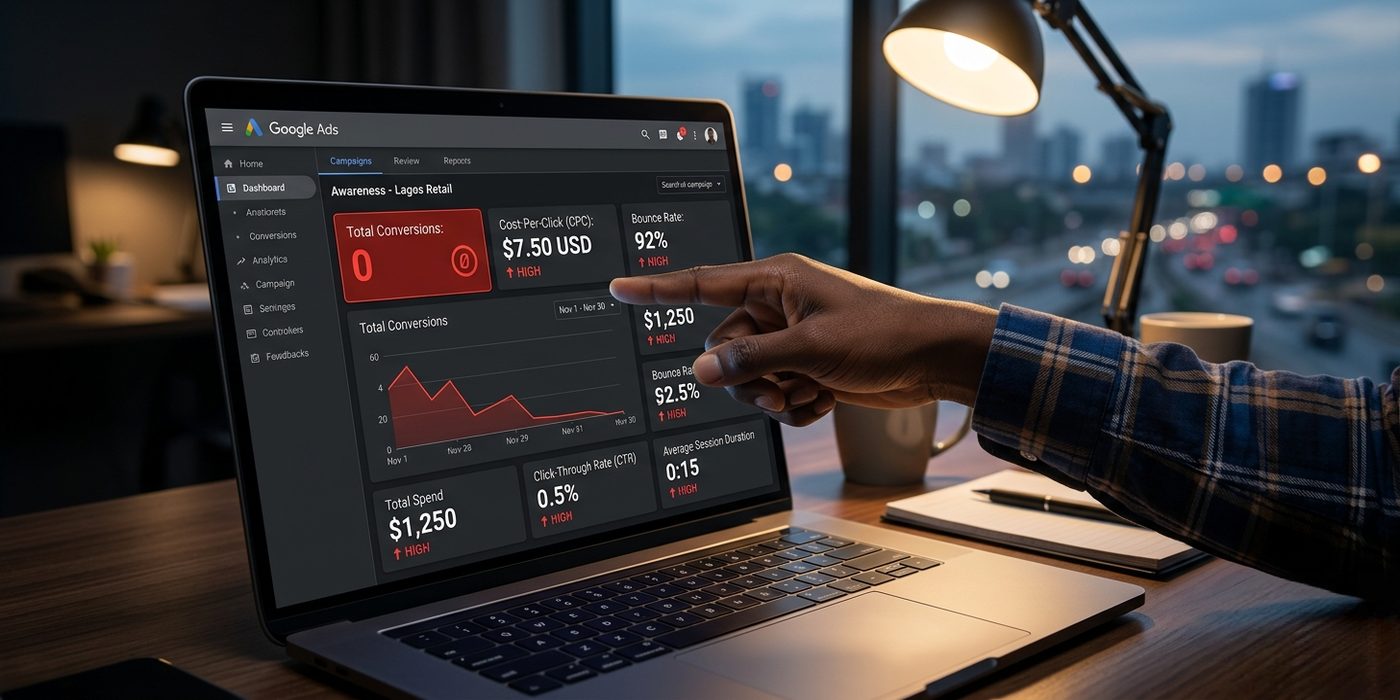
Most content about ads in Nigeria focuses entirely on Facebook and Instagram. Google Ads gets skipped — either because it’s considered too complex or too expensive. The reality is that Google Ads, when structured correctly, can be the highest-intent traffic source a Nigerian service business has access to. Someone searching “professional cleaning service Lagos” on Google is not browsing — they are looking to hire. That intent has a monetary value that Facebook traffic, however well-targeted, rarely matches.
The reason Google Ads wastes money for most Nigerian businesses has three specific causes. First, keyword selection. Running a Google ad campaign without doing proper keyword research means your ad appears for searches that are similar to your service but not actually your buyer. A cleaning company running a broad match keyword like “cleaning” will have their ad shown to people searching for “cleaning hacks,” “cleaning products,” and “self-cleaning ovens.” Every one of those clicks costs money. None of them are buyers.
Second, negative keywords. This is the feature that filters out irrelevant searches — and it’s the feature that nearly every beginner campaign ignores completely. Adding negative keywords like “DIY,” “products,” “how to,” and “free” to your campaign immediately stops your budget from being consumed by people who will never pay for your service.
The Landing Page Problem Is the Same on Both Platforms
Third — and this is the one that connects Google Ads and Facebook Ads into the same root problem — your landing page. Google grades your ad account on something called Quality Score, which is partly determined by how relevant your landing page is to the search term that triggered your ad. A low Quality Score means you pay more per click than your competitors. A high Quality Score means you pay less and rank higher. Most Nigerian business websites have landing pages that are either generic, slow to load on mobile, or simply don’t exist — the ad goes to a homepage that says nothing specific about the service the person was searching for.
This is not a platform problem. It’s a structural one. And it’s why the same business owner who says “Facebook ads don’t work” also says “Google ads are too expensive” — both campaigns were broken at the foundation before a single naira was spent.
Understanding how ads work is one piece. Understanding how to build the full digital presence that supports them is another. Our post on How to Monetize Social Media in Nigeria in 2026 covers exactly that broader picture — the organic and paid ecosystem that makes campaigns sustainable. And if you’re ready to go further, our digital products and resources include tools built specifically to close these gaps faster.
The Exact Mistakes Killing Your Ad Campaigns Right Now
These aren’t hypothetical. These are patterns I see consistently across Nigerian ad accounts — from small businesses spending ₦10,000 a month to brands pushing ₦500,000. The mistakes don’t change with budget. They just become more expensive.
Mistake 1: Boosting posts instead of building campaigns. A boosted post is designed to increase visibility on content you’ve already published. It is not optimised for leads, sales, or clicks to external destinations. Running your business’s paid acquisition through the boost button is like trying to win a race in a taxi. The vehicle exists, but it’s not built for what you’re asking it to do.
Mistake 2: Targeting everyone. “People in Nigeria, age 18–65, all interests” is not a target audience — it’s a wish. Facebook’s algorithm needs signal to find the right people. Wide targeting on a Nigerian account, where CPMs (cost per thousand impressions) are already low, sounds cheap but generates impressions from people who have zero context for your offer. Narrow targeting costs more per impression and converts far better.
Mistake 3: No conversion destination. Sending ad traffic to your Instagram page is one of the most common and most costly mistakes in Nigerian digital marketing. Instagram pages are not landing pages. They do not have one clear offer, one clear CTA, or one clear next step. They are browsing environments — and browsing is not buying.
Mistake 4: Killing campaigns too early. Facebook’s algorithm needs data to optimise. The learning phase — the period during which Facebook tests different audience segments and delivery patterns — requires approximately 50 conversion events before it stabilises. Most Nigerian business owners pause or kill their campaigns after three days of weak results. That’s the equivalent of turning off an oven before the food is cooked and concluding that cooking doesn’t work.
Mistake 5: Ignoring the offer. No amount of targeting precision or creative polish will save an unclear offer. “We offer the best services in Lagos” tells the viewer nothing they can act on. “Free office cleaning assessment this week — book via WhatsApp” gives them something specific to respond to. The offer is the campaign. Everything else supports it.
What Running Ads Correctly Actually Looks Like

Picture this. Your ad goes live on a Monday morning. It’s targeting Lagos residents who match the profile of your ideal client — specific enough to be relevant, broad enough to have volume. Your creative stops their scroll. The copy speaks directly to the problem they’ve been sitting with. They click. They land on a clean, fast, mobile-optimised page with one clear offer and a WhatsApp button.
By Tuesday, you’ve got three enquiries in your inbox. You respond to each one. Two become paying clients within the week. You’ve recovered your entire monthly ad budget from a single campaign — and it’s only day five.
By the end of the month, you’ve got a retargeting campaign running automatically to everyone who clicked but didn’t enquire. You’ve got a WhatsApp broadcast list of warm leads you’re nurturing. You’ve got conversion data that Facebook is using to find more people who look exactly like your existing buyers.
Your ads aren’t a lottery anymore. They’re infrastructure. Predictable. Scalable. You know what a lead costs. You know what a client is worth. And you know that every naira you put into the campaign has a clear path back to revenue.
That’s not a fantasy. That’s what structured campaigns produce. And it starts with fixing the foundation — which is exactly what Ace Digitals Global does. Feel free to get in touch and we’ll take a look at where yours is breaking down.
Ready to Stop Doing This Alone?
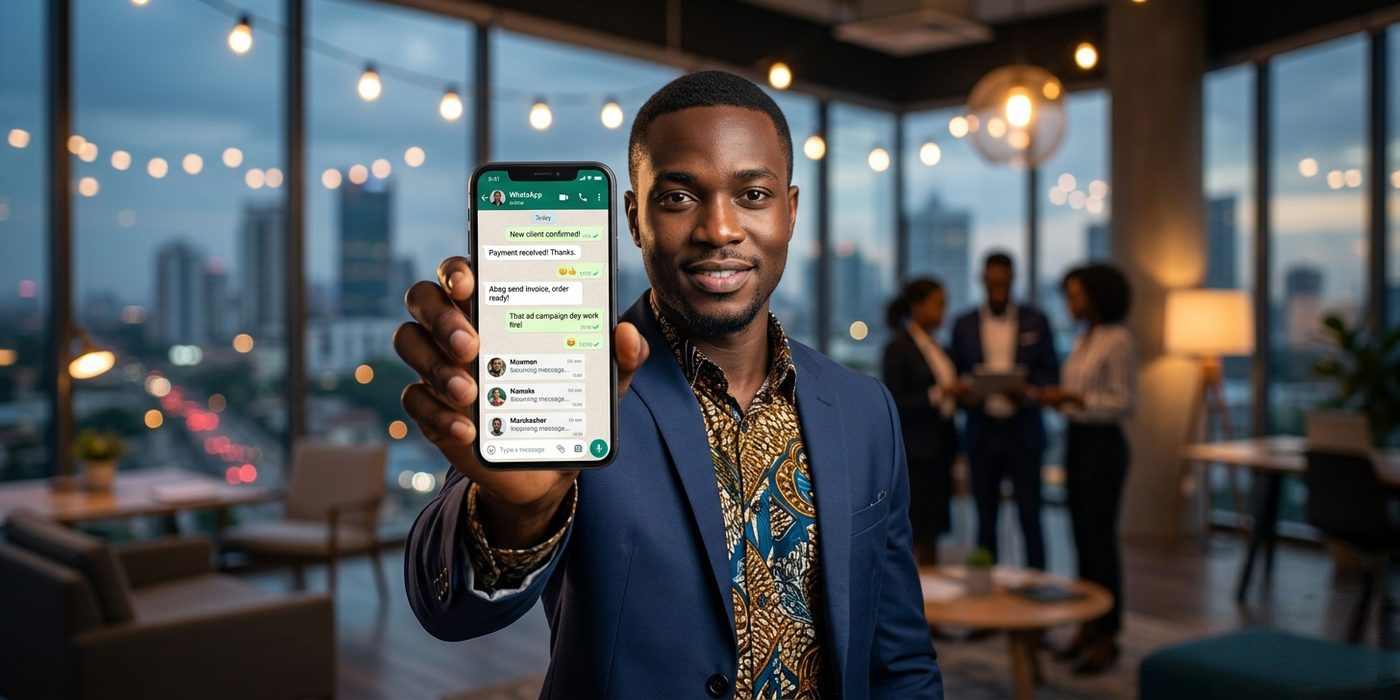
You now know more about why Facebook ads fail than most people running ads in Nigeria right now. You understand the difference between boosting and building. You know what the A.C.E. Framework does and why each phase matters. You’ve seen what the right structure produces — real enquiries, real revenue, real return on spend.
The next move is simple. Let Ace Digitals Global audit your current ads — or build your first real campaign from scratch. Done for you. End to end. No guessing. No wasted budget. Just a campaign built to convert from day one. Check out our full range of services or start the conversation directly below.
Stop spending on ads that don’t convert. Start running campaigns that bring real clients to your business — consistently.
One conversation with DigitalUche is all it takes to change the result.
💬 Chat with DigitalUche on WhatsApp 🌐 Visit Ace Digitals Global 📸 Follow @DigitalUche
Frequently Asked Questions
Why are my Facebook ads not converting even though they’re getting clicks?
Clicks without conversions almost always point to one of two problems: where you’re sending the traffic, or what you’re asking them to do when they get there. If your ad destination is an Instagram page, a generic homepage, or a Facebook post, there’s no conversion mechanism — the viewer has nowhere specific to go and nothing specific to do. Fix the landing destination first, then look at your offer. A specific, time-sensitive offer with a single action (like opening a WhatsApp chat) converts far better than a general “contact us” message. In most cases, the ad itself isn’t the problem — it’s everything that comes after the click.
Is boosting a post the same as running a Facebook ad?
No — and this distinction is one of the most important things a Nigerian business owner can understand before spending another naira. Boosting a post increases its reach and visibility among a broad audience. Running a campaign through Facebook Ads Manager gives you precise control over targeting, campaign objective, placement, budget optimisation, and conversion destination. Boosting is built for engagement and reach. Ads Manager is built for leads, sales, and measurable business outcomes. If your goal is clients — not likes — you need Ads Manager, not the boost button.
How much should a small business in Nigeria spend on Facebook ads?
The honest answer is: less than you think, if the structure is right. A well-built campaign with clear targeting, a strong offer, and a converting landing page can produce results on ₦10,000–₦20,000 per month in the Nigerian market, depending on the service and location. The problem isn’t budget size — it’s budget waste. A ₦50,000 campaign with a broken structure will underperform a ₦15,000 campaign built correctly every single time. Start with a realistic test budget, measure the cost per enquiry, and scale what’s working.
Why is my Google ad spending money but not getting results?
The most common reasons are broad keyword matching, missing negative keywords, and poor landing page relevance. When Google matches your ad to searches that aren’t from actual buyers — because your keywords are too broad — you pay for irrelevant clicks. Adding negative keywords filters those out immediately. Landing page relevance matters too: if someone searches “cleaning service Lagos” and your ad takes them to a homepage about your general business history, they leave. The page needs to match the search intent precisely, with one clear offer and one clear next step.
How long should I run a Facebook ad before deciding it’s not working?
Facebook’s algorithm requires approximately 50 conversion events to exit its learning phase and begin optimising delivery properly. Depending on your budget and campaign structure, this can take 7–14 days. Pausing or killing a campaign after 2–3 days of weak results is one of the most common and costly mistakes Nigerian business owners make — you’re stopping the machine before it has enough data to find its stride. Give a properly structured campaign at least 7 days before drawing conclusions, and look at cost per result rather than just impressions or reach.
What’s the best ad format for a Nigerian service business?
For most Nigerian service businesses — especially those in cleaning, logistics, salons, and professional services — a short video showing real work or real results consistently outperforms static graphics. It doesn’t need production quality. A 20–40 second phone-filmed video of your service in action, with or without captions, stops the scroll and builds instant trust in a way that designed images simply don’t. Pair that with a WhatsApp landing page as the destination and you have the most effective basic campaign structure available in the Nigerian market right now. If you want this built and managed for you, explore our blog for more strategy — or reach out to Ace Digitals Global directly.
The Only Ad Advice That Will Ever Matter
Ads don’t fail because the platforms don’t work. They fail because the structure feeding the platform is broken — wrong audience, wrong destination, wrong offer, wrong expectations. Every naira you’ve spent on ads that didn’t convert wasn’t wasted on Facebook or Google. It was spent before the campaign even launched, in the decisions that shaped how it was built.
You now have the framework to change that. The A.C.E. approach — Attract the right person, Convert them with a clear offer and the right destination, Earn from the relationship that follows — isn’t complicated. It’s just not what the boost button teaches you, and it’s not what the ₦5,000 ad course covers. But it’s what actually works in this market, for businesses like yours, right now.
You don’t have to figure this out through trial and error. That’s already cost you enough. The faster path is a campaign built by someone who’s already on the other side of those lessons.
Stop spending. Start converting. One message changes everything.
Let Ace Digitals Global build, launch, and manage your next campaign — so you can focus on delivering the work, not chasing the leads.
💬 Chat with DigitalUche on WhatsApp 🌐 acedigitalsempire.com 📸 @DigitalUche
The platform never failed you. The structure did — and structure is always fixable.
Want This Implemented for Your Business?
Book a free 30-minute strategy call with DigitalUche — no obligation, just real advice.

Uchenna Richard — DigitalUche
Founder & CEO — Ace Digitals Global
Lagos-based digital marketing strategist helping Nigerian entrepreneurs build websites and run ads that actually convert. Follow on Instagram @DigitalUche.