Key Takeaways
- The platform is not the growth lever. Traffic, offer and a checkout that does not fail on mobile data decide whether the store earns; Shopify versus WordPress decides how much admin you carry while it does or does not.
- Shopify's costs are visible and recurring: subscription, apps, and a transaction fee on online sales when you are on the Basic plan and paying through a third-party gateway. WooCommerce's costs are hidden: hosting, security, plugin renewals and the hours you personally spend keeping it alive.
- Shopify wins for physical-product sellers moving volume who have nobody on the team who wants to touch code. WordPress with WooCommerce wins when content, SEO and a custom build all need to live under one roof and you want to own the asset.
- Bill both over twelve months, not month one. The cheaper option at launch is frequently the more expensive one by month twelve, and the reverse is also true.
- A working store plus paid traffic beats a prettier platform every single time. Fix the traffic before you argue about the CMS.
Pick the wrong platform and you won’t just lose money — you’ll lose months rebuilding from scratch while your competitors are already selling. That’s the real cost of this decision, and it’s why the WordPress vs Shopify debate deserves more than a feature checklist.
Most comparisons stop at monthly pricing. They compare Shopify’s ₦15,000–₦60,000/month subscription against WordPress’s ‘free’ label and call it a draw. What they don’t price is the full 12-month bill: hosting, SSL, premium plugins, payment gateway fees on Paystack or Flutterwave, theme licences, and every hour you spend managing the thing instead of running your business.
That reframe changes everything. Because once you price your own time honestly — at whatever your actual hourly earning rate is — the cheaper platform on paper often becomes the more expensive one in practice.
There’s also one question nobody asks until it’s 11pm and checkout is broken: who fixes this, and how fast? Straddle Homes went from zero digital presence to 150–300 property enquiries in peak months after Ace Digitals Global built their website. Skyline Automobile hit 10 bookings a week. Imójú Eyewear opened an entirely new wholesale revenue channel across multiple states. None of that happens on a platform the owner can’t maintain or a stack that collapses under real traffic.
This post prices both platforms across a full year in naira, accounts for gateway fees, factors in owner time, and gives you a clear decision — not just a comparison. If you want the broader picture on building an online store from scratch, the Online Store Setup Nigeria: Full Steps (2026 Guide) walks through every setup stage. By the end of this post, you’ll know exactly which platform your business can actually afford.
What WordPress vs Shopify Actually Costs a Nigerian Business Owner Over 12 Months
Most people comparing WordPress and Shopify are asking the wrong question. They’re debating features — drag-and-drop editors, theme flexibility, app ecosystems — when the real question is simpler and far more uncomfortable: what does each platform cost you over a full year, including the hours you spend managing it?
Total Cost of Ownership (TCO): The complete 12-month cost of running a platform — covering hosting, themes, plugins or apps, payment gateway fees, and the owner’s own time valued at their actual earning rate. For Nigerian SMEs, TCO is the only honest basis for a platform decision.
Here’s where the debate breaks down in practice. A WordPress site on shared hosting might start at ₦15,000–₦25,000 a year for hosting alone, but add a premium theme (₦30,000–₦80,000 one-off), a page builder licence, a security plugin, a backup plugin, and a WooCommerce payment gateway extension for Paystack or Flutterwave, and your year-one bill is already sitting between ₦120,000 and ₦250,000 before you’ve written a single product description. Shopify’s Basic plan runs around $29/month — roughly ₦45,000–₦50,000 at current rates — plus transaction fees on top of Paystack’s own processing charges if you’re not on Shopify Payments, which isn’t available in Nigeria. That stacks up to ₦540,000–₦600,000 annually just at the subscription level.
Numbers tell one part of the story. The other part is what happens at 11pm on a Friday when your checkout stops processing orders. Who fixes it? On WordPress, that’s you, your developer on retainer, or whoever picks up at the hosting company’s support line. On Shopify, it’s their 24/7 support team — but only if the problem sits within Shopify’s own code, not a third-party app you installed. The honest answer is that neither platform makes you immune to downtime. The difference is who absorbs the cost of fixing it.
That reframe — total naira outlay plus the value of your own time — is exactly what turns this from a features argument into a decision. Straddle Homes, for example, came to Ace Digitals Global before they’d even launched operations. We built their website from scratch, and property enquiries started climbing immediately — reaching between 150 and 300 enquiries in peak months across their website and social media. The platform choice wasn’t made on features. It was made on what would generate leads reliably without demanding constant owner attention. That’s the question worth asking before you read another spec comparison.
If you want a full breakdown of what a high-converting store setup actually looks like in the Nigerian market, the Online Store Setup Nigeria: Full Steps (2026 Guide) walks through the complete process, platform decision included. The real cost comparison — stack by stack, naira by naira — is what the rest of this post covers.
Why Everyone Keeps Picking the Wrong Platform — and Paying for It Twice
Most Nigerian business owners choose between WordPress and Shopify the same way they buy a phone on Twitter: by reading specs. Storage. Themes. Apps. Features. It sounds like research. It isn’t. Because the real question isn’t which platform does more — it’s which one costs less over a full year, once you add every line item you didn’t see on the pricing page.
That’s where the confusion lives. Shopify quotes you $29/month. Nobody mentions the 2% transaction fee on every sale unless you use Shopify Payments — which isn’t available in Nigeria, so you’re using Paystack or Flutterwave, and you’re paying that fee on every order. WordPress looks free until you price out hosting on Bluehost or Namecheap, a premium theme, WooCommerce extensions, an SSL certificate, and a caching plugin that keeps the site from dying when three people visit at once. By month twelve, neither platform is what the homepage said it was.
The second thing nobody talks about is time. When Straddle Homes started receiving 150 to 300 property enquiries in peak months through their website, that volume only converted because the site stayed up and the contact forms worked. A broken checkout or a failed form at 11pm on a Friday isn’t a minor inconvenience — it’s lost revenue and a damaged reputation. Someone has to fix it. The question every business owner should be asking before they sign up for anything is: when something breaks at 11pm, who exactly is picking up that call?
If the answer is ‘me,’ then your platform choice is also a decision about how many late nights you’re willing to work for free. Bill your hours honestly — at whatever your time actually earns — and add that to the annual cost. For most SME owners, that figure changes the whole conversation. You can read about Online Store Setup Nigeria: Full Steps (2026 Guide) to see exactly what that setup timeline looks like in practice.
The advice circulating in Nigerian entrepreneur WhatsApp groups doesn’t help either. ‘Just use Shopify, it’s easier.’ ‘WordPress is better, you own everything.’ Both statements are true in certain conditions and useless without context. Someone who shifted ₦50,000 in soaps per month doesn’t have the same calculus as a wholesaler processing bulk orders across five states. When Imójú Eyewear moved from retail-only to receiving weekly wholesale bulk orders after their e-commerce build and Meta Ads went live, it wasn’t because they picked the cheapest platform — it was because the platform matched the sales process they were actually running. That fit matters more than the feature list.
The feature debate persists because it’s easier to compare bullet points than to do the maths. It takes ten minutes to read a Shopify vs WordPress article. It takes honest accounting — hosting, apps, gateway fees, your own hours — to see which one actually fits your business. That’s the work most people skip. And it’s exactly why they end up rebuilding the whole thing six months later.
How Do You Choose Between WordPress and Shopify? Price It With A.C.E.
Both platforms do the same three jobs. The A.C.E. Monetization Framework — Attract, Convert, Earn — simply forces you to price them honestly instead of arguing about menus.
Attract: Where Do Your Buyers Actually Search?
Content-led traffic favours WordPress. Every product page and blog post you publish can rank in Google without another monthly subscription. If your buyers arrive from Instagram DMs and Meta Ads instead of search, Shopify’s hosted speed earns its fee back on one metric only: fewer abandoned carts.
Convert: What Happens After the Ad Spend Lands?
Paystack and Flutterwave plug into both platforms, so payment gateways are not the tiebreaker. The monthly bill is. A typical WooCommerce plugin and app stack runs ₦15,000 to ₦40,000, while Shopify bundles payments, tax and refunds into one dashboard for its own fee. We built Imójú Eyewear’s store on WordPress and ran Meta Ads behind it — weekly wholesale bulk orders from other states followed, because the checkout worked, not because the platform was fashionable.
Earn: Who Fixes the Checkout at 11pm?
Nobody pricing a platform answers this question, so answer it yourself: bill your own hours. Three evenings a month chasing plugin conflicts or a broken gateway, costed at what your time actually earns, usually erases WordPress’s price advantage. If nobody on your team can touch a theme file, hosting plus maintenance is the real twelve-month number — not the subscription fee.
Price both over a full year, add gateway fees, then decide. The WordPress route is walked through step by step in our online store setup guide.
How Do You Compare WordPress vs Shopify Costs Step by Step?
Skip the feature lists. Build one 12-month bill per platform, add your own hours, and the WordPress vs Shopify choice usually shows itself in ten minutes.
- Price the fixed lines. WordPress means hosting, domain, theme and plugins. Shopify means the monthly plan, theme and apps. Get current naira quotes for each. If a tool bills in dollars, price it at the rate you’ll actually pay, card fees included.
- Add gateway fees. Both connect to Paystack or Flutterwave. Apply each gateway’s current rate to your expected monthly sales and multiply by twelve. Then check whether your Shopify plan adds its own transaction charge on top.
- Bill your hours. Estimate the monthly hours you’ll spend on updates, plugin conflicts and fixes. Multiply by what an hour of your time earns.
- Answer the 11pm question. If checkout breaks tonight, who fixes it, and what do they charge? Imójú Eyewear started receiving weekly wholesale bulk orders after we built their e-commerce website and ran Meta Ads. A checkout that stays down overnight is exactly where orders like that get lost.
Illustrative example, not a client case: assume your hour earns ₦5,000. Platform A looks ₦150,000 cheaper over the year but costs six extra hours a month. That’s 72 hours, or ₦360,000 of your time. The ‘cheaper’ option loses by ₦210,000.
Verdict: Which Platform Wins for Which Business?
| Use case | Winner | Why |
|—|—|—|
| Solo seller, nobody technical on call | Shopify | Hosted setup, fewer parts to break |
| Content or SEO-led business | WordPress | Full control of blog and ranking |
| Business with a developer on retainer | WordPress | Flexible, and fixes are covered |
For most small Nigerian product sellers with no technical help, Shopify wins the 12-month bill. WordPress wins once someone maintains it or content drives your sales. See Best WordPress Setup For High Conversions or Online Store Setup Nigeria: Full Steps (2026 Guide) before you commit.
Which Platform Actually Costs More Once You Bill Your Own Hours?
Run the numbers across twelve months and the gap nearly closes. Shopify Basic sits near $29 monthly, roughly ₦540,000 a year at current rates, before a single app. A WordPress store on good local hosting, a premium theme and two paid plugins typically lands lower. Then the bill flips at 11pm.
Imójú Eyewear went from retail-only to weekly wholesale bulk orders after we built their store and ran Meta Ads. That growth means the checkout cannot afford to break. On Shopify, support carries that risk. On WordPress, you or your developer does, and hardening it starts with the best WordPress setup for high conversions.
Owner-hours cost: The naira value of the time you personally spend running a platform, covering updates, plugin conflicts, Paystack or Flutterwave fixes and checkout debugging, priced at what an hour of your business actually earns rather than what a freelancer charges.
Six hours a month billed at ₦15,000 an hour is ₦1.08 million a year. That single figure settles what no feature chart will.
What Are the Biggest Mistakes to Avoid When Comparing WordPress vs Shopify?
Mistake one: pricing a single month and calling it a year. Shopify renews in dollars monthly, while WordPress front-loads development then adds hosting and plugin renewals — the cheaper option in January often isn’t cheaper by December.
Mistake two: ignoring your own hours. Bill every evening spent on setup, fixes and plugin updates at what your time actually earns. A ₦150,000 saving vanishes once you lose twenty evenings to it.
Mistake three: forgetting renewal and gateway fees. Charges of roughly 1.5% plus ₦100 per transaction on Paystack or Flutterwave quietly compound, and both Shopify apps and WooCommerce extensions bill again every year whether or not you noticed.
Mistake four: choosing the prettier demo over answering who fixes the checkout at 11pm. If that person is you, WordPress flexibility becomes a second job; if you have no developer on call, Shopify support earns part of its fee. If you do build on WordPress, start from a proven setup that converts instead of guessing. Add both totals up, and the decision takes ten minutes.
Real Nigerian Businesses That Let the Platform Decision Speak for Itself
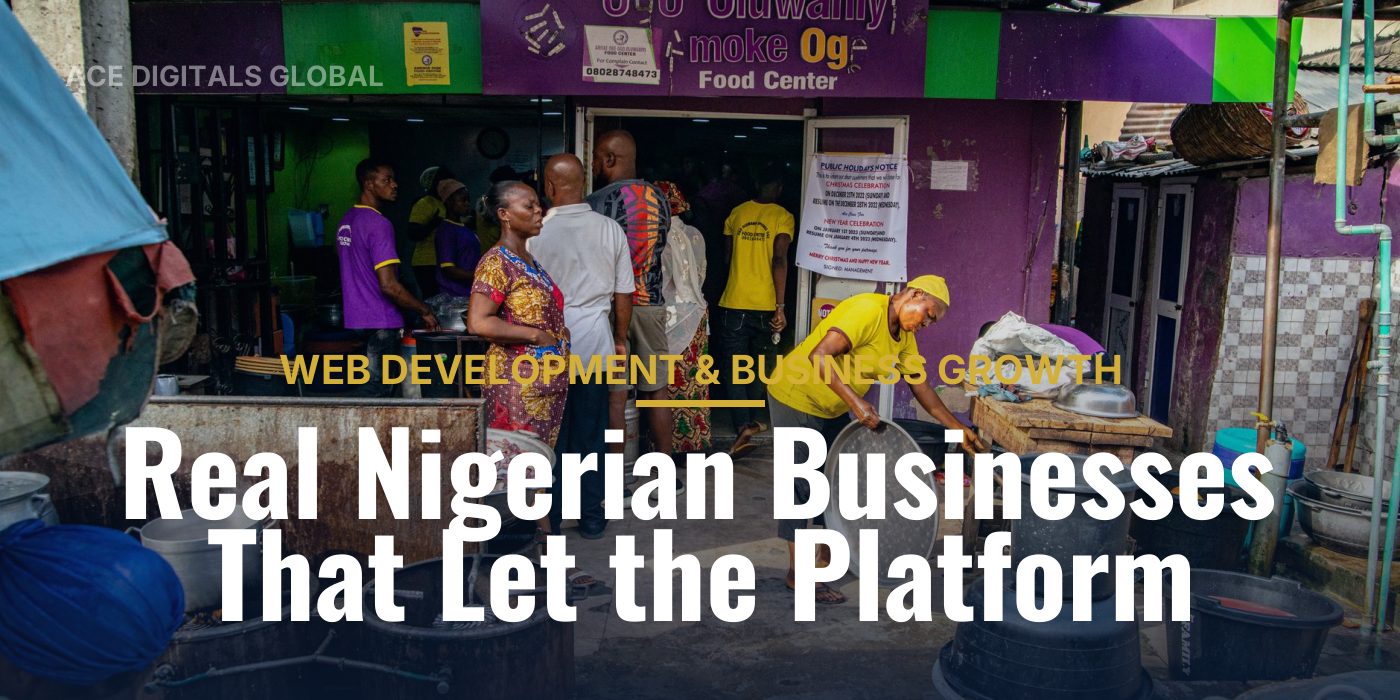
Arguments about features are easy to find. What’s harder to find is proof that the platform choice actually changed a business’s revenue. Here’s what happened when real Nigerian businesses stopped debating and started building.
Imójú Eyewear was doing what most small retailers do — waiting for walk-in customers and hoping the week would be kind. After Ace Digitals Global built their e-commerce website and paired it with Meta Ads, something the shop floor could never deliver started happening: bulk wholesale orders, arriving every week, from buyers in different states entirely. That’s not an incremental improvement. That’s a new revenue channel that retail alone structurally cannot produce.
Skyline Automobile had word of mouth. It works until it doesn’t. After their website went live, enquiries started arriving through the contact page and the phone didn’t stop. The owner now handles up to 10 bookings a week — and contracts a friend’s brand to absorb the overflow. His bottleneck shifted from ‘how do I get clients’ to ‘how do I serve them all.’
‘I wanted something simple but I got design of the best quality.’
— Sunny Olabamidele
Straddle Homes didn’t even have a website when they launched. Ace Digitals Global built theirs before operations began. Property enquiries climbed week on week across the site and social media — hitting between 150 and 300 enquiries in peak months. The pipeline didn’t come from an agent network or billboard spend. It came from a website that was built correctly from day one.
None of these outcomes came from picking the platform with the better-looking dashboard. They came from matching the right build to the right business goal — and from having someone in your corner at 11pm when something breaks. If you want to see how the same logic applies to your own setup, the Online Store Setup Nigeria: Full Steps (2026 Guide) walks through exactly that, and our Best WordPress Setup for High Conversions breaks down what a correctly built site actually looks like under the hood.
This Could Be Your Story Next
Chinedu, Blessing and Tunde didn't start with an advantage. They started with a system. Let's build yours — message us today and tell us where your business is stuck.
Frequently Asked Questions: WordPress vs Shopify for Nigerian Businesses
Is WordPress or Shopify cheaper for a Nigerian small business in 2026?
WordPress is cheaper over 12 months for most Nigerian SMEs — but only when you account for every real cost. A self-hosted WordPress store on a local plan like QServers or WhoGoHost runs ₦80,000–₦150,000 per year including hosting, a premium theme, and WooCommerce extensions. Shopify’s Basic plan alone costs roughly ₦180,000–₦220,000 at current exchange rates, before apps.
Can I pay for Shopify in Nigeria without a dollar card?
Yes, but it takes deliberate setup. Shopify bills in USD, so you need a virtual dollar card from providers like Grey, Chipper Cash, or a Zenith/GTBank domiciliary card. Naira Mastercards and Verve cards are declined at checkout. That extra friction — and the monthly exchange-rate exposure — is a real running cost many Nigerian owners discover only after they have already built their store.
Which platform handles Paystack and Flutterwave better for Nigerian checkouts?
Both platforms support Paystack and Flutterwave, but WordPress with WooCommerce gives you more control. The official Paystack WooCommerce plugin is free, well-maintained, and handles bank transfers, USSD, and card payments without a revenue share. Shopify charges an additional 0.5–2% transaction fee if you use a payment gateway outside Shopify Payments — and Shopify Payments is not available in Nigeria.
What happens when my checkout breaks at 11pm — who fixes it?
That question decides everything. On Shopify, you open a support ticket and wait — your store is on their infrastructure and their timeline. On WordPress, whoever built and maintains your site is your first call. That is exactly why Straddle Homes went from zero web presence to 150–300 property enquiries in peak months — Ace Digitals Global built the site and stayed accountable after launch, not just at handover.
How do I get started with Ace Digitals Global?
The fastest way is to chat with us on WhatsApp — tell DigitalUche where your business is right now and what platform decision you are stuck on, and you will get a straight answer, not a sales script. You can also browse our full range of services to see exactly what we build and how we price it.
Which Platform Should You Pick? Price the Year, Then Decide
The WordPress vs Shopify debate ends when you stop comparing features and start comparing bills. Price twelve months in naira: hosting, apps, plugins, Paystack or Flutterwave fees, plus your own hours at what your time actually earns. Then ask who fixes the checkout at 11pm when it breaks.
You can do that sum in ten minutes. If you want a second pair of eyes on it, Online Store Setup Nigeria: Full Steps (2026 Guide) walks through the setup side.
Open a spreadsheet tonight, fill in both columns, and let the total pick for you.
Ready to Stop Guessing?
You don't need another course or another random tactic. You need the A.C.E. system applied to your business. One conversation is all it takes to start.
Disclosure: this post was drafted with AI assistance. Every price, result and claim in it comes from a source cited in the article or from our own published client work — we never invent numbers.
Want This Implemented for Your Business?
Book a free 30-minute strategy call with DigitalUche — no obligation, just real advice.

Uchenna Richard — DigitalUche
Founder & CEO — Ace Digitals Global
Lagos-based digital marketing strategist helping Nigerian entrepreneurs build websites and run ads that actually convert. Follow on Instagram @DigitalUche.