Key Takeaways
- SEO is not dead — but the version built on keyword stuffing, low-quality backlinks, and thin content is finished. Google's AI Overviews and smarter ranking systems have killed that approach.
- What works in 2026 is topical authority: covering a subject in depth, with real experience signals (E-E-A-T), structured so that both Google and AI answer engines can extract and cite your content.
- For Nigerian businesses, local SEO — Google Business Profile, location-specific content, and mobile-first site speed — is one of the least competitive and highest-return opportunities still available.
- AI Overviews do reduce clicks on some queries, but they increase brand visibility for sites that are cited inside them. The goal shifts from ranking number one to being the source AI references.
- The businesses that will win organic traffic in Nigeria over the next two years are the ones that build content around genuine expertise, structure it for answer engines, and pair it with a conversion system that turns that traffic into leads.
SEO isn’t dead. The lazy version of it is, and it’s been dying quietly for years. Keyword stuffing, backlink farming and thin 400-word posts won’t get you anywhere now. So is SEO dead or evolving in 2026? It’s evolving, and the people still ranking are the ones who stopped gaming Google and started earning trust.
I’ve built and ranked sites in this market long enough to see the shift happen. Google didn’t kill SEO. It just got better at spotting people who were faking it. Meanwhile, AI search tools now pull answers from pages that are clearly structured and written by someone who knows the subject.
Here’s a real example. Skyline Automobile ran on word of mouth for years. After Ace Digitals Global built their website, enquiries started arriving through the contact page and phone calls, up to 10 bookings per week. The owner says it keeps him so busy that he sometimes hands the overflow to a friend’s brand. That’s what a findable, trusted site does for a local business.
The old tactics are what stopped working, not search itself. In this post, I’ll show you what to drop, what to build instead, and how to do it with Nigerian search intent in mind, from topical authority to Google Business Profile Nigeria: Free Setup Guide (2026) basics. By the end, you’ll know exactly where your SEO stands.
Is SEO Dead or Evolving in 2026? What Actually Broke
SEO isn’t dead. The lazy version of it is, and most Nigerian businesses are still paying for that version. The real mistake isn’t bad keywords or weak backlinks. It’s treating Google like a vending machine: insert 20 keywords, collect traffic. That approach stopped working long before 2026. Underneath it sits the deeper problem, which is that nobody asked what the searcher actually needed.
Topical Authority: A site’s proven depth on one subject, built through interlinked pages that answer every related question a searcher might ask. Google and AI answer engines favour sources that cover a topic completely, not pages that simply repeat a keyword.
Skyline Automobile shows the other side. They ran on word of mouth for years. After Ace Digitals Global built their website, enquiries started arriving through the contact page and phone calls, up to 10 bookings a week. The site gave local buyers something real to find and trust. Before you buy a single backlink, set up your Google Business Profile properly.
Why Do People Still Ask if SEO Is Dead in 2026?
The myth survives because it pays. Anyone selling a ₦15,000 course on secret SEO hacks needs you to believe the old playbook still works; anyone whose site tanked needs a villain. Both stories travel faster than the dull truth — the tactics broke, not the discipline. Whether SEO is dead or evolving in 2026 depends entirely on who you’re asking, and most of the people answering are selling something.
Three things keep the loop running. Bad advice recycled by people who’ve never ranked a page. Wrong tools used — Rank Math installed, Search Console ignored. Fundamentals skipped: no Google Business Profile, no service pages, no clear answer to what the business actually sells.
Then the platform shifts and everyone panics. AI Overviews take the click; zero-click results climb. Yet Skyline Automobile needed no trick. After we built their site, contact-page enquiries and phone calls started producing up to 10 bookings a week — enough that the owner farms overflow out to a friend’s brand. That’s a page answering search intent properly, not an algorithm hack.
The mindset gap is the real ceiling. People want a shortcut that makes ranking permanent instead of the boring work that makes it likely. If budget is your blocker, read what SEO actually costs for a small business in Nigeria before you buy another cheap course.
How Does the A.C.E. Framework Fix SEO in 2026?
The fix is structural, not tactical. A.C.E. — Attract, Convert, Earn — treats search as a funnel instead of a keyword list, and that distinction is what separates sites still growing in 2026 from sites waiting on a recovery that isn’t coming.
Attract: Build Topical Authority, Not Keyword Pages
One page that answers a real question cluster beats twenty thin posts. Claim and optimise your Google Business Profile too — for local intent it often surfaces before your site does. Skyline Automobile ran on word of mouth for years; once we built their site and structured it for local search, enquiries started arriving through the contact page and phone calls, up to 10 bookings a week, with the overflow going to a partner brand.
Convert: Write for the Answer Engine and the Human
Open every section with the direct answer, then put the evidence underneath. Answer engines lift the first clean sentence; readers stay for the proof. Add FAQ blocks, a named author, and real dates. Thin content doesn’t fail because it’s short — it fails because it says nothing checkable.
Earn: Measure Enquiries, Not Rankings
Rankings are a leading indicator, never revenue. Track calls, form fills and WhatsApp messages per page. And budget honestly: what SEO actually costs a Nigerian small business is far less than people assume — provided you’re paying for structure, not monthly optimisation theatre.
How Do You Rebuild Your SEO for 2026, Step by Step?
Run these five steps in this order. Skip ahead and you’ll pay for traffic you can’t convert.
Step 1: Claim your local footprint first
Set up and complete your Google Business Profile before you touch a blog. Skyline Automobile ran on word of mouth for years. Once their website went live, enquiries started coming through the contact page and by phone, up to 10 bookings a week. That’s local intent doing its job.
Step 2: Pick one topic and own it
Choose one buyer-led topic and write every supporting page around it. Ten connected pages beat fifty random ones.
Step 3: Structure pages so AI answers can lift them
Open each section with the direct answer. Add a table where the data allows it, and finish with real FAQs. Google’s AI answers and tools like ChatGPT pull from pages built this way.
Step 4: Show proof you’ve done the work
Use first-hand photos, named results and an author who’s visible. Anonymous, generic copy is what 2026 filters out.
Step 5: Measure leads, not rankings
Track calls, WhatsApp clicks and form fills. Before you commit a budget, read what SEO costs small businesses in Nigeria.
| Old SEO | 2026 SEO |
|—|—|
| Keyword stuffing | Answer-first sections |
| Bought backlinks | Local citations and real mentions |
| Thin 300-word posts | Topic clusters with proof |
| Rank for traffic | Rank for calls and WhatsApp leads |
Worked example (illustrative, not a documented campaign)
Business: a dental clinic in Ikeja, Lagos. Offer: teeth scaling and polishing. Destination: one service page with a WhatsApp button, backed by four supporting posts on dental costs and aftercare.
Budget and timeline: roughly ₦150,000 over 90 days, mostly writing and page building. That’s an estimate, so adjust it to your writer’s rates.
- Search Console impressions: if they’re flat after 6 weeks, rewrite the page openings.
- WhatsApp clicks: if impressions climb but clicks don’t, fix the offer and the button placement.
- Booked appointments: if clicks come but bookings don’t, fix how the clinic responds on WhatsApp.
Why Do Sites With Fewer Pages Rank Higher in 2026?
Here’s the pattern I keep seeing: the client sites that rank in 2026 publish less, not more. Skyline Automobile ran on word of mouth for years. We rebuilt their site around what buyers actually search — vehicle type, location, availability — and enquiries moved to the contact page and phone. Bookings climbed to roughly 10 a week, enough that the owner now passes overflow to a friend’s brand.
Nothing there was technical wizardry. It was structure, intent and proof. Search rewards a site that covers one subject thoroughly, with a real business and real contact details behind it. Thin keyword pages dilute the exact signal you’re trying to build.
Topical Authority: The depth of coverage one website holds on a single subject, measured by how completely and consistently its pages answer the related questions in that niche. It’s earned page by page through genuine expertise, not by publishing 200 short posts that each chase a different keyword.
One properly built cluster beats ten scattered posts, every time. How much SEO costs for small businesses in Nigeria covers the budget side of that trade-off.
What SEO Mistakes Should You Avoid in 2026?
Five mistakes keep sinking Nigerian sites, and none of them is that SEO died.
Stuffing keywords into every line
Repeating a phrase twenty times reads as spam to Google and to people. Write one clear answer per page, then back it with real detail.
Buying backlinks in bulk
Cheap link packages rarely help and can risk penalties. Earn mentions from Nigerian directories, press and partners instead.
Publishing thin posts
Five hundred generic words give AI answers nothing to quote. Cover one topic deeply, with a table and a direct answer up top.
Ignoring local search intent
Skyline Automobile went from word of mouth to up to 10 bookings a week once their website was built to be found. Set up your Google Business Profile first, then match how Nigerians actually search.
Hiring without knowing the price
Read how much SEO costs for small businesses in Nigeria before signing, so a vague promise doesn’t drain your ₦ budget.
What Proof Is There That SEO Still Works in Nigeria in 2026?
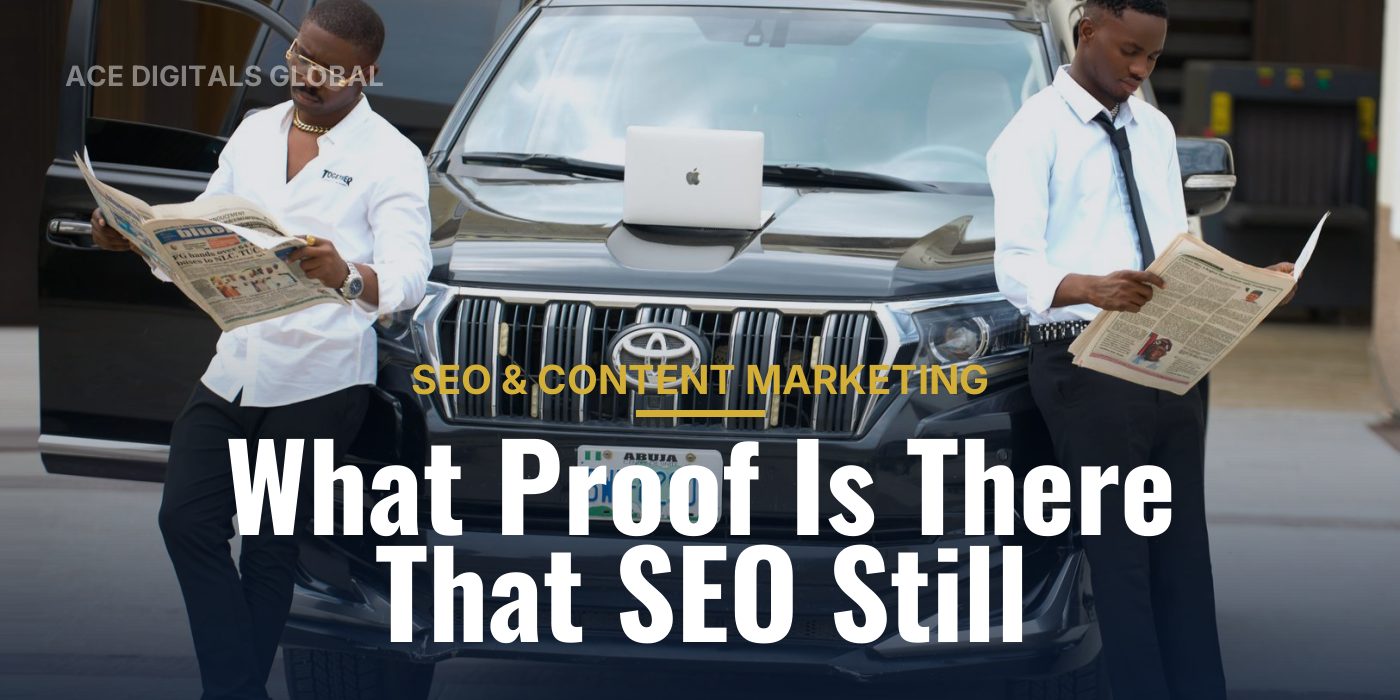
Skyline Automobile ran on word of mouth for years. No site, no rankings, no enquiries beyond the people who already knew the brand. Ace Digitals Global built them a website and set it up so buyers searching for what they sell locally could actually find them. Bookings started coming through the contact page and straight phone calls — up to 10 per week.
The owner says it keeps him so busy that he sometimes contracts a friend’s brand to handle the overflow.
Nothing exotic happened there. A real business met real local search intent. If you’re weighing what proper work like that costs, my breakdown of SEO costs for small businesses in Nigeria gives you the honest figures before you commit a naira.
This Could Be Your Story Next
Chinedu, Blessing and Tunde didn't start with an advantage. They started with a system. Let's build yours — message us today and tell us where your business is stuck.
Is SEO Dead or Evolving in 2026? Your Questions Answered
Is SEO Dead or Evolving in 2026? What Actually Broke?
SEO isn't dead. The lazy version of it is, and most Nigerian businesses are still paying for that version.
Why Do People Still Ask if SEO Is Dead in 2026?
The myth survives because it pays. Anyone selling a ₦15,000 course on secret SEO hacks needs you to believe the old playbook still works; anyone whose site tanked needs a villain.
How Does the A.C.E. Framework Fix SEO in 2026?
The fix is structural, not tactical. A.C.E.
How Do You Rebuild Your SEO for 2026, Step by Step?
Run these five steps in this order. Skip ahead and you'll pay for traffic you can't convert.Step 1: Claim your local footprint firstSet up and complete your Google Business Profile before you touch a blog.
Why Do Sites With Fewer Pages Rank Higher in 2026?
Here's the pattern I keep seeing: the client sites that rank in 2026 publish less, not more. Skyline Automobile ran on word of mouth for years.
Is SEO dead in 2026?
No, SEO isn’t dead. The lazy version is. Keyword stuffing, bought backlinks and thin pages have lost ground, while topical authority, real expertise and clear structure still bring traffic. People still search Google every day, and someone has to be the answer they find.
Does AI search replace SEO?
No, AI search doesn’t replace SEO; it often draws on the same pages. Tools like Google AI Overviews pull from content that’s clearly structured, specific and trustworthy. Answer the question in the first lines, use headings and tables, and you give both Google and AI assistants something to quote.
How much does SEO cost for a small business in Nigeria?
SEO costs for Nigerian small businesses depend on competition, your starting website and how much content you need. A local service business needs far less than a national online store. Our guide to SEO costs for small businesses in Nigeria lays out what drives the price before you hire anyone.
Does Google Business Profile help local SEO in Nigeria?
Yes, a Google Business Profile helps local SEO in Nigeria. It puts you on Google Maps and in local results for searches like ‘car dealer in Lekki’. Verify it, add accurate hours, photos and your phone number, then collect genuine reviews. Our Google Business Profile setup guide walks you through it.
How do I get started with Ace Digitals Global?
The easiest way is to chat with us on WhatsApp and tell us where your business is stuck. You’ll get a straight answer on what to fix first. You can also look through our full range of services to see how we handle websites, ads and SEO.
Is SEO Dead in 2026? The Verdict, and Your Next Move
SEO isn’t dead. The lazy version is — keyword-stuffed pages, bought links, thin content that answered nothing. What replaced it rewards patience: topical authority, visible expertise, and pages built so both Google and AI answer engines can pull from them.
That’s the verdict in one line. The Nigerian businesses ranking right now aren’t luckier or bigger than you. They fixed the foundation first and let compounding handle the rest.
Every week you wait, a competitor publishes the page your customer finds instead of yours. Pick one cluster, sort out your Google Business Profile, and start today.
Ready to Stop Guessing?
You don't need another course or another random tactic. You need the A.C.E. system applied to your business. One conversation is all it takes to start.
Disclosure: this post was drafted with AI assistance. Every price, result and claim in it comes from a source cited in the article or from our own published client work — we never invent numbers.
Want This Implemented for Your Business?
Book a free 30-minute strategy call with DigitalUche — no obligation, just real advice.

Uchenna Richard — DigitalUche
Founder & CEO — Ace Digitals Global
Lagos-based digital marketing strategist helping Nigerian entrepreneurs build websites and run ads that actually convert. Follow on Instagram @DigitalUche.